Quads
Depth Jump
The Depth Jump is a plyometric exercise with no equipment for your quads. Share of the load in the Zulta muscle model: gluteus maximus 17%, quads (vastus lateralis) 17% and calves (gastrocnemius) 14%.
Also known as: drop jump
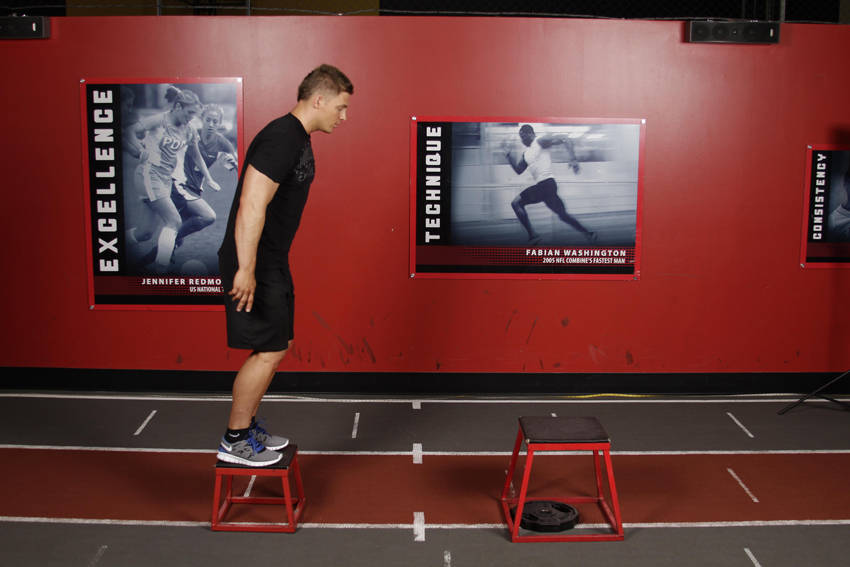
How to do it
- Stand on the edge of a box about knee height, feet hip-width.
- Step off the box and drop straight down.
- Land on both feet with the knees slightly bent.
- Rebound immediately into a maximal vertical jump, swinging the arms up.
- Land softly, then step back onto the box to reset.
Tips
- Spend as little time on the ground as possible between landing and jump.
- Use a box height from which you can still jump higher than your normal jump.
- Keep the reps low and fully rested.
Common mistakes
- Sinking into a deep squat on landing, which kills the rebound.
- Hopping up before stepping off.
- Using a box that is too high.
Muscles worked by the Depth Jump
Share per muscle in the Zulta muscle model. The model spreads the load of one rep over 40 muscles, based on EMG and biomechanics research.
Stepping off a box: a hard eccentric landing. Two-footed jumps are a fast countermovement of hips, knees and ankles: glutes, quads and calves produce the force and absorb the landing.
Depth Jump alternatives
Same equipment
Different equipment
Easier
Make it easier
Similar exercises
Frequently asked questions
What muscles does the Depth Jump work?
Mainly the gluteus maximus, quads (vastus lateralis), calves (gastrocnemius) and quads (vastus medialis). The calves (soleus), quads (rectus femoris) and hamstrings (biceps femoris) assist.
Is the Depth Jump good for beginners?
The Depth Jump is rated advanced. If you are new, learn the Box Step Up Jump first and build up from there.
What is a good alternative to the Depth Jump?
For example the Depth Drop, Drop Jump and Box Jump. They train mostly the same muscles.
Log your sets in Zulta
Zulta tracks your sets, weights and muscle load next to your running, riding or Hyrox training. The app opens soon.