Quads
Overhead Squat
The Overhead Squat is a strength exercise with a barbell for your quads. Share of the load in the Zulta muscle model: gluteus maximus 17%, quads (vastus lateralis) 15% and quads (vastus medialis) 12%.
Also known as: ohs
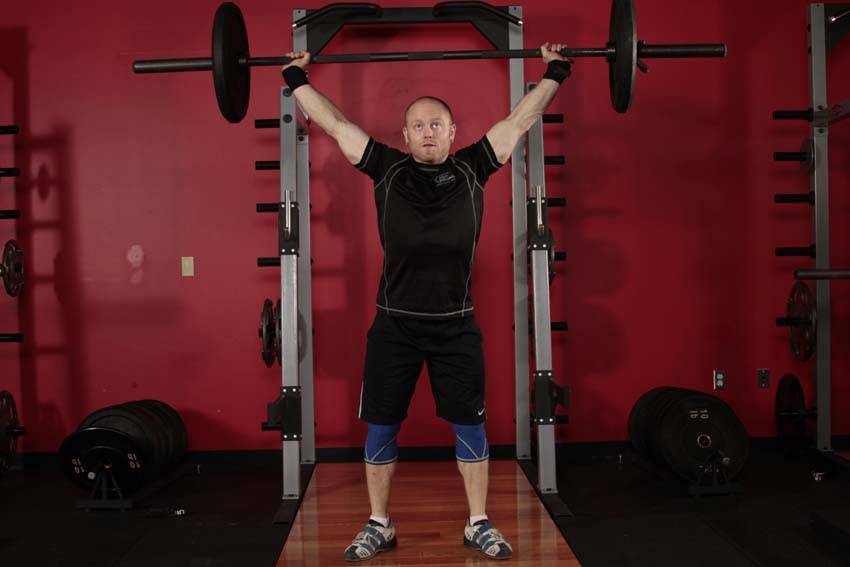
How to do it
- Take a wide snatch grip on the bar and press or jerk it to straight arms over the head.
- Set the feet shoulder-width, toes slightly out, with the bar over the back of the neck and the arms locked.
- Brace the core and actively push the bar up while you sit down between the heels.
- Descend until the hips are below the knees, keeping the bar over the middle of the foot.
- Stand back up with the arms locked and the bar in the same line.
Tips
- Push up into the bar the whole time, as if trying to stretch it apart.
- Keep the torso as upright as possible so the bar stays balanced.
Common mistakes
- Letting the bar drift forward in front of the face.
- Bending the elbows under load.
- Heels lifting as the depth increases.
Muscles worked by the Overhead Squat
Share per muscle in the Zulta muscle model. The model spreads the load of one rep over 40 muscles, based on EMG and biomechanics research.
Holding the load overhead needs shoulder and trunk stability. Knees and hips flex and extend together under load: the vasti and glute max are the prime movers, the adductors extend the hip from the bottom, and the erectors hold the torso.
Overhead Squat alternatives
Same equipment
Different equipment
Easier
No equipment
Make it easier
Similar exercises
Frequently asked questions
What muscles does the Overhead Squat work?
Mainly the gluteus maximus, quads (vastus lateralis) and quads (vastus medialis). The adductors, spinal erectors (lower back) and quads (rectus femoris) assist.
Is the Overhead Squat good for beginners?
The Overhead Squat is rated advanced. If you are new, learn the Hatfield Squat first and build up from there.
What is a good alternative to the Overhead Squat?
For example the Overhead Squat Single Arm, Kettlebell Overhead Squat and Anderson Squat. They train mostly the same muscles, some with different equipment.
Sources
- Escamilla 2001, MSSE 33(1):127-141 (knee biomechanics of the squat)
- Kubo et al. 2019, Eur J Appl Physiol 119(9):1933-1942 (squat depth and adductors)
- Gullett et al. 2009, JSCR 23(1):284-292 (front vs back squat)
Log your sets in Zulta
Zulta tracks your sets, weights and muscle load next to your running, riding or Hyrox training. The app opens soon.