Quads
Sissy Squat
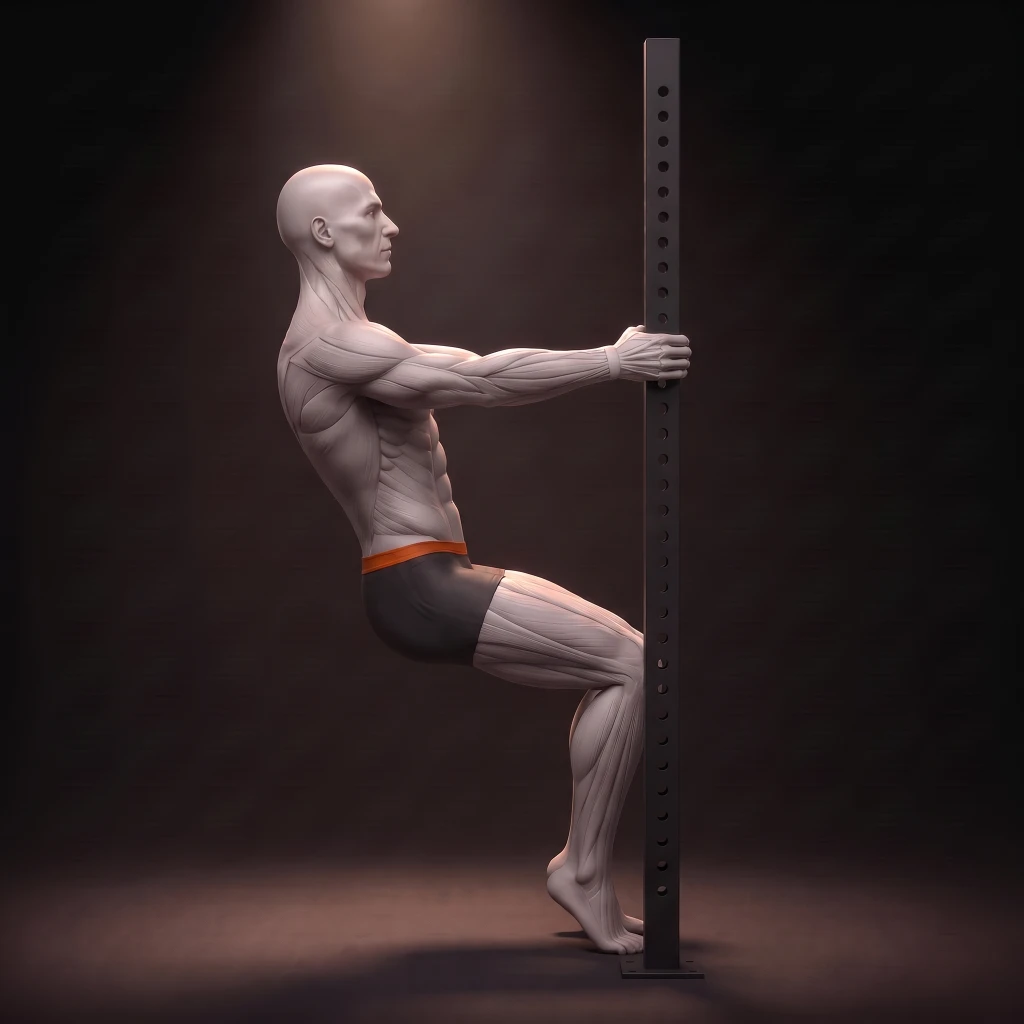
The Sissy Squat is a strength exercise with no equipment for your quads. Share of the load in the Zulta muscle model: quads (rectus femoris) 34%, quads (vastus lateralis) 31% and quads (vastus medialis) 27%.
Also known as: knee extension squat
How to do it
- Stand next to a rack upright and hold it lightly with one hand, feet hip-width.
- Rise onto the balls of the feet.
- Push the knees forward and lean the body back, keeping a straight line from knees to shoulders.
- Lower until the knees are deeply bent and the thighs are close to parallel with the floor.
- Drive the knees back to return to standing, keeping the hips extended.
Tips
- Keep the hips pushed forward: the knees do all the bending.
- Use the hand only for balance.
Common mistakes
- Bending at the hips so it turns into a normal squat.
- Dropping into the bottom without control.
- Pulling on the upright to stand up.
Muscles worked by the Sissy Squat
Share per muscle in the Zulta muscle model. The model spreads the load of one rep over 40 muscles, based on EMG and biomechanics research.
With the hips extended the rectus femoris works from a long length. Knee extension with the thigh fixed isolates all four quadriceps heads; nothing else moves.
Sissy Squat alternatives
Same equipment
Different equipment
Easier
Make it easier
Frequently asked questions
What muscles does the Sissy Squat work?
Mainly the quads (rectus femoris), quads (vastus lateralis) and quads (vastus medialis).
Is the Sissy Squat good for beginners?
The Sissy Squat is rated advanced. If you are new, learn the Leg Extension first and build up from there.
What is a good alternative to the Sissy Squat?
For example the Reverse Nordic, Sissy Squat Machine and Standing Leg Extension. They train mostly the same muscles, some with different equipment.
Sources
- Escamilla et al. 1998, MSSE 30(4):556-569 (open vs closed chain)
Log your sets in Zulta
Zulta tracks your sets, weights and muscle load next to your running, riding or Hyrox training. The app opens soon.