Quads
Tuck Jump
The Tuck Jump is a plyometric exercise with no equipment for your quads. Share of the load in the Zulta muscle model: gluteus maximus 17%, quads (vastus lateralis) 15% and calves (gastrocnemius) 13%.
Also known as: knee tuck jump
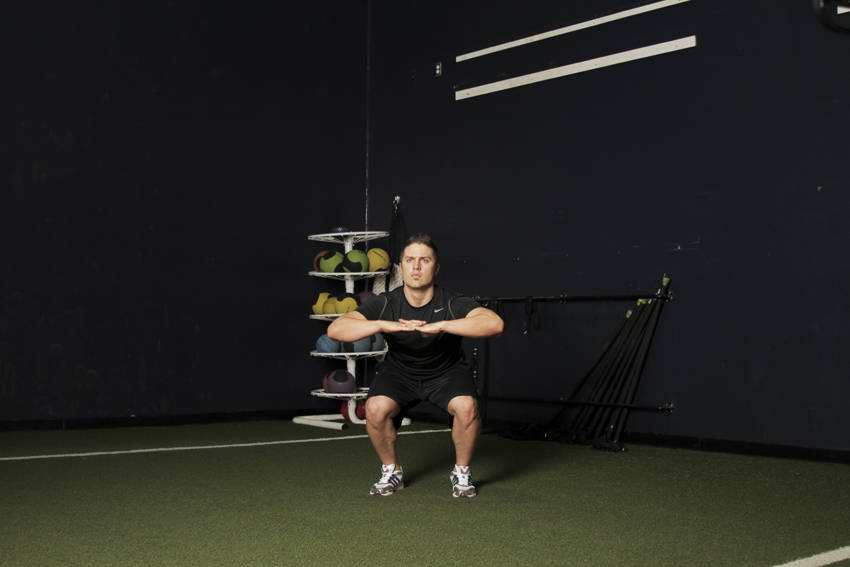
How to do it
- Stand with feet hip-width, arms bent in front of the body.
- Dip into a quarter squat.
- Jump straight up and pull both knees up toward the chest.
- Extend the legs again before landing.
- Land softly on the balls of the feet and flow into the next jump.
Tips
- Drive the knees up to the hands rather than bringing the chest down to the knees.
- Keep the torso upright in the air.
- Keep the landing quiet and quick.
Common mistakes
- Hunching the back to meet the knees.
- Landing with the legs still tucked.
- Landing heavy on the heels.
Muscles worked by the Tuck Jump
Share per muscle in the Zulta muscle model. The model spreads the load of one rep over 40 muscles, based on EMG and biomechanics research.
The knees are pulled up in the air. Two-footed jumps are a fast countermovement of hips, knees and ankles: glutes, quads and calves produce the force and absorb the landing.
Tuck Jump alternatives
Same equipment
Different equipment
Make it harder
Similar exercises
Frequently asked questions
What muscles does the Tuck Jump work?
Mainly the gluteus maximus, quads (vastus lateralis), calves (gastrocnemius) and quads (vastus medialis). The calves (soleus), quads (rectus femoris) and hamstrings (biceps femoris) assist.
Is the Tuck Jump good for beginners?
Yes. The Tuck Jump is rated beginner in the Zulta library: the technique is easy to learn with a light weight.
What is a good alternative to the Tuck Jump?
For example the Frog Jump, Star Jump and Box Jump. They train mostly the same muscles.
How do you make the Tuck Jump harder?
Add weight or reps, or move on to the Frog Jump and Box Step Up Jump.
Log your sets in Zulta
Zulta tracks your sets, weights and muscle load next to your running, riding or Hyrox training. The app opens soon.