Shoulders
Dumbbell Front Raise
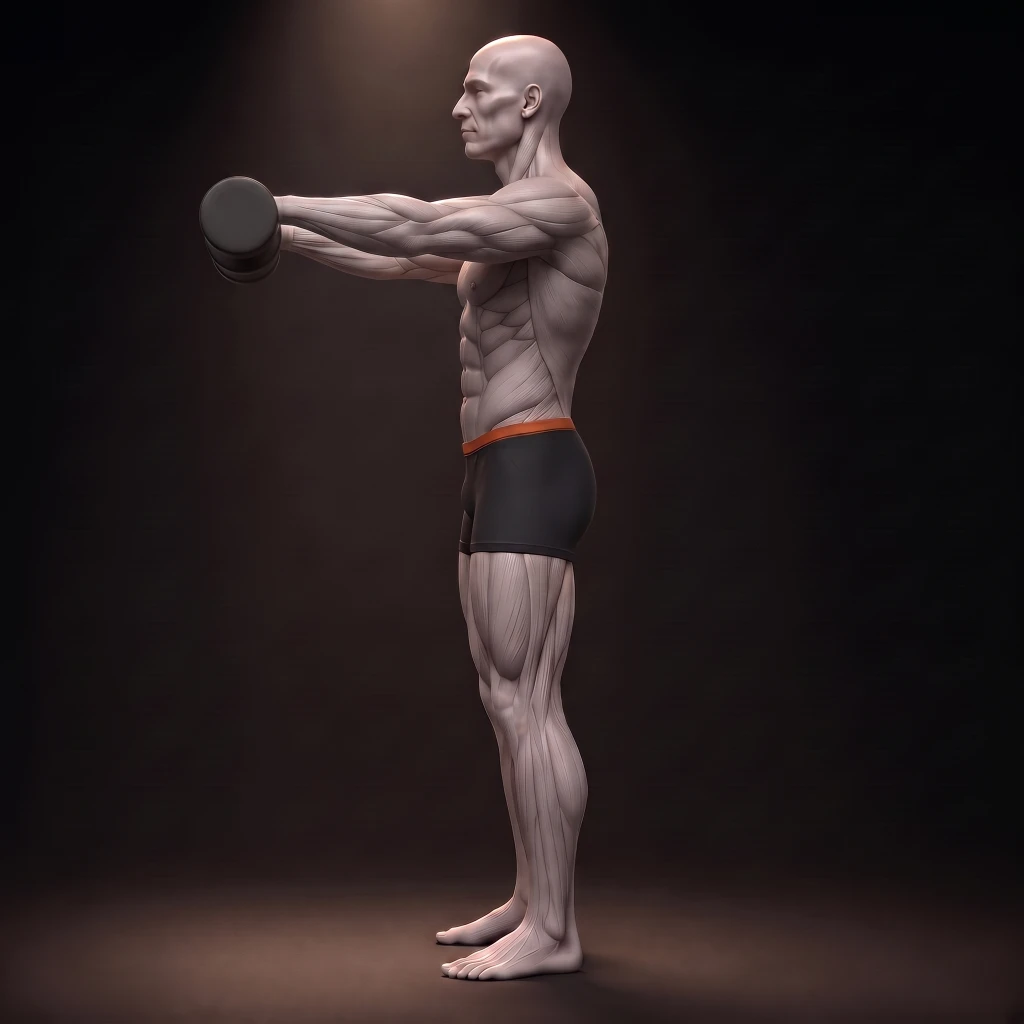
The Dumbbell Front Raise is a strength exercise with dumbbells for your shoulders. Share of the load in the Zulta muscle model: front delts 58%, side delts 14% and upper chest 12%.
Also known as: db front raise
How to do it
- Stand with a dumbbell in each hand, feet hip-width, knees soft.
- Hold the dumbbells in front of the thighs, palms facing the body.
- Raise both arms straight forward with slightly bent elbows.
- Stop when the hands reach shoulder height.
- Lower slowly back to the thighs.
Tips
- Brace the stomach so the weights do not pull you forward or make you lean back.
- Keep the shoulders down and away from the ears.
- Lower slower than you lift.
Common mistakes
- Swinging the weights up with the hips.
- Raising the dumbbells far above shoulder height.
- Locking the elbows straight.
Muscles worked by the Dumbbell Front Raise
Share per muscle in the Zulta muscle model. The model spreads the load of one rep over 40 muscles, based on EMG and biomechanics research.
Raising the arm forward is shoulder flexion: front delt first, lateral delt and clavicular pec next, with serratus and upper traps rotating the shoulder blade.
Dumbbell Front Raise alternatives
Same equipment
Different equipment
Make it harder
Similar exercises
Frequently asked questions
What muscles does the Dumbbell Front Raise work?
Mainly the front delts. The side delts and upper chest assist.
Is the Dumbbell Front Raise good for beginners?
Yes. The Dumbbell Front Raise is rated beginner in the Zulta library: the technique is easy to learn with a light weight.
What is a good alternative to the Dumbbell Front Raise?
For example the Barbell Front Raise, Cable Front Raise and Cable Front Raise (Bar). They train mostly the same muscles, some with different equipment.
How do you make the Dumbbell Front Raise harder?
Add weight or reps, or move on to the Barbell Front Raise and Plate Front Raise.
Sources
- Coratella et al. 2020, IJERPH 17(17):6015 (frontal raise)
Log your sets in Zulta
Zulta tracks your sets, weights and muscle load next to your running, riding or Hyrox training. The app opens soon.