Glutes
Reverse Hyperextension
The Reverse Hyperextension is a strength exercise on a machine for your glutes. Share of the load in the Zulta muscle model: gluteus maximus 39%, spinal erectors (lower back) 21% and hamstrings (biceps femoris) 17%.
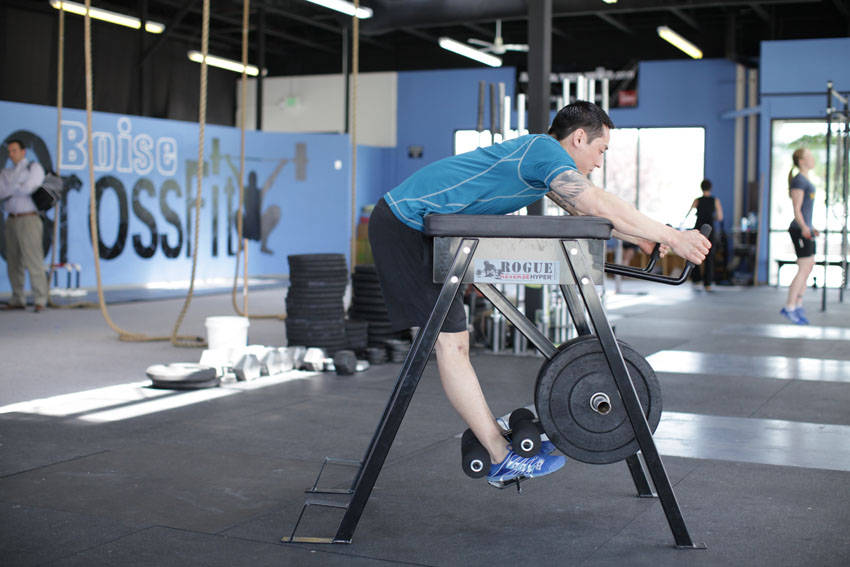
How to do it
- Lie face down on a reverse hyper station or high box with your hips at the edge and legs hanging down.
- Grip the front handles or the edge of the station to hold the torso in place.
- Keep the legs straight and together.
- Raise the legs behind you by squeezing the glutes until they are in line with the torso.
- Lower the legs slowly back to the hanging start.
Tips
- Keep the torso pressed flat into the pad the whole time.
- Squeeze and hold for a second at the top of each rep.
Common mistakes
- Kicking the legs up with momentum.
- Arching the lower back by lifting the legs too high.
- Letting the torso slide forward on the pad.
Muscles worked by the Reverse Hyperextension
Share per muscle in the Zulta muscle model. The model spreads the load of one rep over 40 muscles, based on EMG and biomechanics research.
The legs swing up while the torso is fixed. Extending the hips and spine from a flexed position against gravity: erectors and glutes lead, hamstrings assist; rounding or keeping the spine neutral shifts the share between back and glutes.
Reverse Hyperextension alternatives
Same equipment
Different equipment
Easier
No equipment
Make it harder
Make it easier
Frequently asked questions
What muscles does the Reverse Hyperextension work?
Mainly the gluteus maximus. The spinal erectors (lower back), hamstrings (biceps femoris) and hamstrings (semitendinosus/-membranosus) assist.
Is the Reverse Hyperextension good for beginners?
The Reverse Hyperextension is rated intermediate. If you are new, learn the 45 Degree Hyperextension first and build up from there.
What is a good alternative to the Reverse Hyperextension?
For example the Reverse Hyper (Bench), Reverse Hyper Machine and 45 Degree Hyperextension. They train mostly the same muscles, some with different equipment.
How do you make the Reverse Hyperextension harder?
Add weight or reps, or move on to the Weighted Hyperextension and Jefferson Curl.
Log your sets in Zulta
Zulta tracks your sets, weights and muscle load next to your running, riding or Hyrox training. The app opens soon.